
Innovation
How a Tesla Coil Works ⚡ How to Make a Tesla Coil
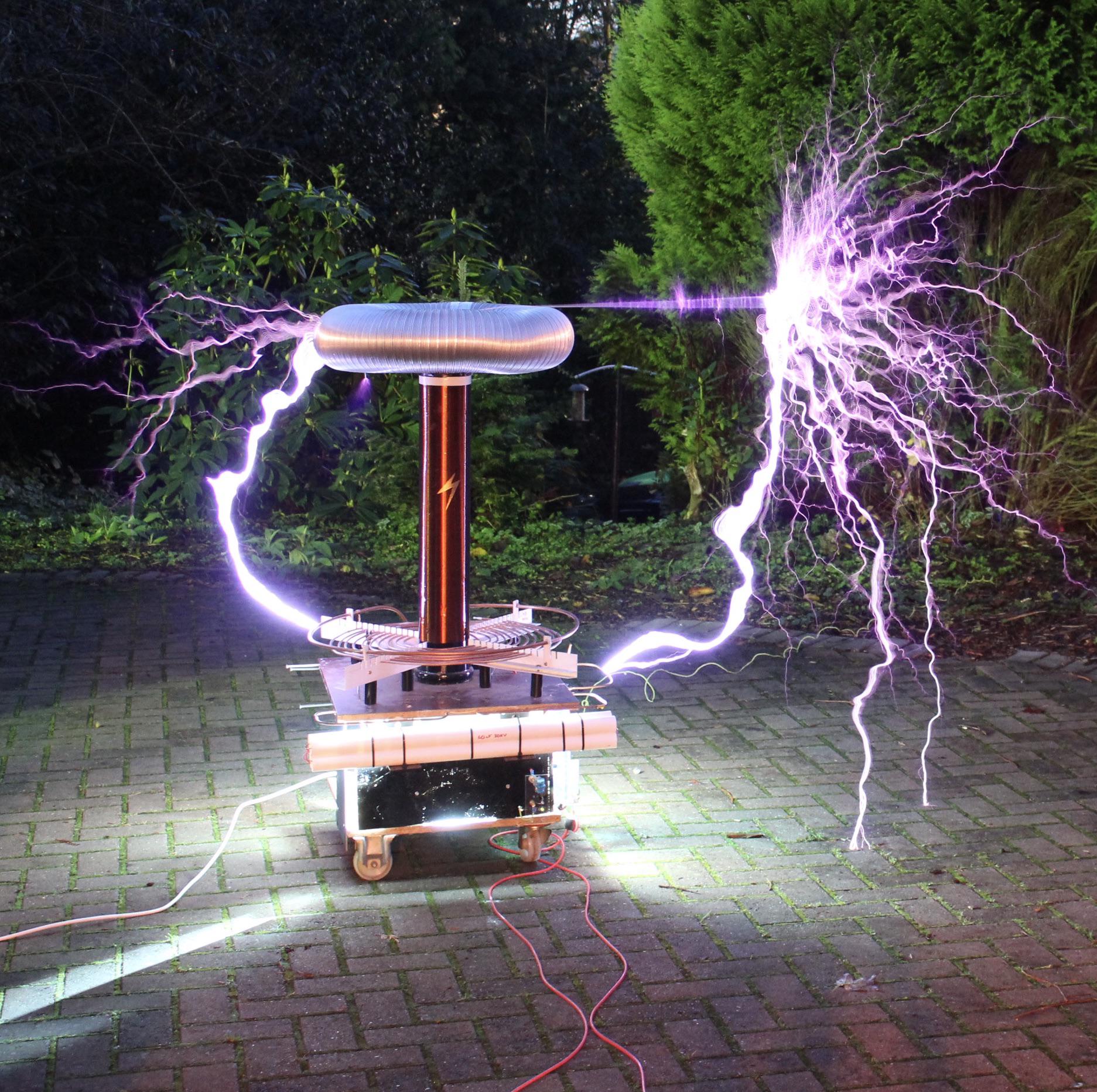
Nikola Tesla is probably one of the most appreciated scientists in the field of electronics because of all the inventions and technological advances that we use to this day. The two topics most influenced by him are the use of alternating current and wireless power transmission. And it is precisely the latter of which I want to talk to you in this episode, as specifically through one of his most recognized inventions.
In this episode we will see how a Tesla coil works. Before talking about how and why a Tesla coil is capable of generating those gigantic electric arcs, we have to understand what Nikola Tesla’s objective and logic was when developing this device. In the previous episode we talked about how an inductor or coil works, and I explained how an electric current flowing through a coil can generate a magnetic field.
And also how the variation of a magnetic field can induce a current in another coil. Understanding these two physical phenomena, it is easy to assume that we could apply current to a coil to generate a magnetic field, and in turn use this magnetic field to induce a current in a nearby coil, with which we would be transmitting power wirelessly. The problem with this idea is that magnetic fields lose their strength quickly as we move away from the source.

And therefore, when separating the two coils the energy transmission becomes more and more inefficient. Now let’s see how the Tesla coil overcomes this limitation taking this concept to the extreme. The logic is the same, to make an alternating current go through a coil, but with extremely high voltage, and a specific frequency to be able transmit energy over greater distances.
To achieve this goal there are mainly two concepts that we must understand. The first is the voltage rise through a transformer which in simple terms is made up of two coils. A primary winding, which is connected to a current source and generates a magnetic flux, and a secondary winding, which converts again that magnetic flux in a current.
But the interesting thing is that if the number of turns on the secondary winding is greater than the number of turns in the primary winding, an output voltage larger than the input is generated. A simple way to visualize this behavior could be to imagine that we have a few batteries in series. Every time we add a new stack, the voltage adds up.
Now, if we make an analogy, with each turn of the secondary coil we will realize that each one of them acts as a voltage source, just like batteries, and therefore every time we add a new loop it will add that voltage to the total. And although in the next video we will talk in more depth about how a transformer works, I still haven’t mentioned one of its characteristics which is extremely important to the operation of Tesla coils. Magnetic coupling.
This characteristic refers to the efficiency with which the primary coil affects the secondary coil. That is, if an alternating current wave enters by the primary coil, the wave that will come out of the secondary coil will have the same shape, but with a different voltage. In most cases, the idea is that the coupling is as high as possible, but not on Tesla coils, precisely because of the second concept that governs their behavior, using a resonant circuit.
A resonant circuit is made up of an inductor and capacitor, which as we have seen in previous episodes, are components capable of storing energy, although they do it in a different way, the capacitor with an electric field, and the inductor with a magnetic field. The effect of connecting these two components in a closed circuit is that, in theory, we could keep an electric current flowing cyclically indefinitely. Let’s suppose that initially the capacitor is charged.
Being in a closed circuit, it will start to discharge, and by doing this a current will go through the inductor, which will start to form a magnetic field. But when all the charges of the capacitor have been used, this magnetic field will begin to lose its strength, inducing a current in the opposite direction and recharging the capacitor until the inductor loses all its magnetic field starting the cycle again. Clearly, in the real world this is not going to happen indefinitely because the circuit itself has a resistance which will gradually slow down the electron movement.
But this does not mean that we cannot benefit from this behavior. A resonant circuit has two great benefits. The first one is that even when they can’t hold energy indefinitely, they can do it for a certain period of time, although losing strength in each cycle, something similar to what would happen in a pendulum which just by pushing it once is able to keep oscillating at a regular frequency.
And also like a pendulum, if we push it periodically at the exact moment, we can amplify the end result, even though we are only applying the same amount of force that we had initially used. The second benefit of resonant circuits is linked to the fact that they have their own frequency at which they oscillate, which is defined only by characteristics of its components. That is to say, the inductance of the inductor and the capacitance of the capacitor.
Taking this into account, the inductor of the circuit will generate an electromagnetic field whose oscillation is going to be equal to said frequency, which let’s remember, is constant. And did you know that another object does something similar? A tuning fork, which when hit, generates a specific frequency. And I mention it because you surely have heard of the following experiment.
In which, when putting two tuning forks with the same frequency of vibration and hitting just one of them, eventually the second tuning fork will start to vibrate because the pressure changes traveling through the air from the first tuning fork will move the second one just at the exact moment so that their movement is amplified. Exactly as in the case of the pendulum. So thanks to this behavior, if we position two resonant circuits, but only the first one is active, eventually electromagnetic waves generated by its inductor will begin to induce and amplify a current in the inductor of the second resonant circuit, enabling power transmission wirelessly over much greater distances.
Having taken all of this out of the way, now we are able to go back to our Tesla coil to see how it works. Nowadays, there are several ways to get the same or better results, but we are going to focus on one of the original models because of their simplicity. The first thing we will need is an alternating current source, which will be connected to a common transformer.
That is to say, with a high magnetic coupling between the two coils. With this, we will obtain an alternating current with higher voltage, but whose frequency is equal to that of the initial source, say 50 or 60 Hz. This new alternating current is brought to a resonant circuit with its corresponding capacitor and inductor, which is usually called the primary coil.
Also including an extra component which serves as a switch, which basically consists of two pieces of metal that are extremely close, but not touching. The function of this section of the Tesla coil, is that the primary coil emits an electromagnetic field with the frequency of resonant circuit. When the transformer induces a current, charges begin to accumulate in the capacitor without having any other possible way, but as the source voltage grows with each oscillation, the electrons try to find another path.
And the second best option is where the metal pieces are, jumping through them with a spark. This way, the spark will allow the passage of the charges that were accumulating in the capacitor, quickly discharging it. But as soon as they do, the spark will also disappear, because the capacitor will be again the best path for the current, repeating the cycle again.
This time the cycle will not be at the same frequency, that the initial transformer was giving us, but rather the frequency at which sparks occur, and the capacitor charge and discharge. That is, the intrinsic frequency of the resonant circuit. But now let’s forget about the capacitor, and let’s focus on the primary coil.
Again, it will be passing an extremely high voltage, which will be oscillating at the frequency of the resonant circuit, and therefore it will generate an electromagnetic field oscillating at this same frequency, which we can take advantage of with the secondary coil. Again, we will have two coils nearby, and with a big difference between the number of turns of each, which means that we will have a second transformer in our Tesla coil. This will increase the voltage in the secondary coil, which by the way, if we analyze independently, is connected to ground, and in its upper part it has a metallic piece of toroidal shape.
It has this shape mainly to be able to accumulate a greater charge and prevent it from ending up escaping into the environment by the corona effect, and therefore also preventing the voltage of the assembly from increasing further. If you remember the episode on spiders that fly using electricity, I mentioned that the corona effect generally occurs when there is a large potential difference between an element and the environment around it, which is accentuated in high and pointed places like the masts of a ship. Well, the top of a Tesla coil is just the opposite, or at least attempts to be, because by preventing charges from moving into the environment they begin to accumulate.
And finally there comes a point where, again, the potential difference will be enough to ionize the air around it, but this time with much more energy, because we had more accumulated charges and ready to jump, generating the electric shocks everyone knows and loves from Tesla coils, but that’s not all about how a Tesla coil works. Do you remember the properties of resonant circuits that I mentioned at the beginning? Although it doesn’t seem like it, the section with the secondary coil and toroid form a new resonant circuit in which there is not a physical capacitor but a capacitance. More specifically, a parasitic capacitance, a phenomenon that occurs whenever two conductors with different voltages are relatively close.
And I say relatively because when we are talking about voltages as high as a Tesla coil, which can reach several hundred or thousands of kilovolts, this phenomenon may be noticeable among conductors who may be several centimeters away or even meters away. Now that we are clear that two resonant circuits exist, in theory we could take advantage of its ability to transmit energy more efficiently. But for this to happen, both circuits must have the same resonant frequency and the resonant frequency of the section with the secondary coil cannot be precisely modified because there is no capacitor to which we can measure its capacitance.
For this reason, some method is usually included to vary the capacitance of the first resonant circuit in such a way that both are the same frequency. With all this, we would only be missing one more feature to fully understand how it works. Did you think it was going to be something simpler? Me too, but we are talking about an invention of Nikola Tesla.
No wonder it is often said that he was ahead of his time. So breathe, subscribe, give oxygen to your brain, and let’s continue. The last detail of the operation of a Tesla coil is in the form of the primary coil, which is designed with the aim of reducing the magnetic coupling between both coils.
In practical terms, this means that when a voltage oscillation goes through the primary coil, the secondary coil will generate a higher voltage for the difference in the number of laps between both coils. But it will also continue to oscillate, even if the primary coil stopped working. Do you remember the pendulum example? It’s exactly the same.
We could say that the secondary coil is the pendulum, and the primary coil is the force that pushes at the exact moment. In this way it is possible to generate a much higher voltage than the one that had been started, and which is also oscillating at the resonant frequency. Now that we fully understand how a Tesla coil works, let’s get back to its goal, transmitting power wirelessly.
The electrical discharges in the air are striking, but in reality do not fulfill any function. We could even say that they are undesirable, so we will keep our Tesla coil at a lower voltage to avoid these losses, and to only generate the electromagnetic field. If we position a fluorescent lamp near the coil, it will turn on, because to the electromagnetic field will give it enough energy so that the gas inside start emitting ultraviolet light, which is later transformed by a phosphor layer in visible light, in a similar way to what we saw in the episode on how a light emitting diode works.
But this way we will not take advantage of the potential of the Tesla coil at all, since we are not using its resonant circuit quality. In fact, the distance at which the lamp will light is quite short. The true way to use a Tesla coil to transmit power wirelessly is using another resonant circuit with the same frequency.
In this way we can be much further and still generate an electric current as a result, just like the tuning fork we mentioned at the beginning. And now to close this video, the million-dollar question, why don’t we use this technology to have wireless power everywhere? And the answer is that we do use it. Practically every day.
Just think of a radio signal. On the one hand we will have a giant antenna emitting electromagnetic frequencies, and on the other hand the radio that in its interior has a resonant circuit that we can adjust to receive only the frequency that interests us. Now how to use those frequencies to transmit information is another story, maybe for a next episode.
Remember to subscribe, share and support me in Patreon, if you think what I do is worth it. See you in the next episode.