

Culture & Arts
Global Vision: Protected Landscapes Reimagined as High-Vibration Zones for Future Territorial Renewal
Across continents, a new and rapidly expanding perspective is reshaping how humanity relates to some of the world’s most treasured protected landscapes. From ancient forests in Europe to sacred mountain ranges in Asia and indigenous heritage zones in the Americas, a growing movement is reinterpreting these areas not only as ecological reserves, but also as “energetic spaces” — locations where nature, culture, and human awareness converge in unique and influential ways.
While traditional conservation focuses on biodiversity, climate stability, and ecosystem protection, this emerging approach adds an additional layer: the idea that certain environments hold distinctive qualities of human perception, cultural meaning, and collective well-being. Advocates describe these regions as “high-resonance territories,” where silence, geological formations, water systems, and untouched biodiversity contribute to a sense of psychological clarity and emotional balance.
From Conservation to Conscious Territory Design
In several countries, pilot initiatives are exploring how protected areas could be modernized without compromising ecological integrity. The goal is not urbanization in the conventional sense, but rather territorial enhancement — integrating sustainable infrastructure, ecological education centers, low-impact visitor pathways, and digital interpretation layers that allow people to engage more deeply with the landscape.
Proponents of this vision argue that such enhancements could help bridge the gap between modern society and natural environments, encouraging responsible visitation while strengthening cultural and environmental awareness.

In this framework, “modernization” does not imply industrial expansion, but rather intelligent design systems that support both preservation and human experience.
Sacred Geography and Cultural Memory
Many of the regions discussed in this movement already hold long-standing spiritual or cultural significance. Indigenous traditions, ancient pilgrimage routes, and historical land practices often identify certain mountains, rivers, and forests as places of reflection, healing, or transformation.
Anthropologists note that these interpretations are deeply rooted in human history, even if expressed in different cultural languages. Today’s renewed interest in these ideas is being framed less as mysticism and more as cultural geography — the study of how people assign meaning to natural spaces.
The Debate: Science, Symbolism, and Sustainability
The concept of “vibration” in landscapes remains controversial within scientific communities. Ecologists and geographers caution against replacing measurable environmental data with metaphorical interpretations. However, interdisciplinary researchers acknowledge that human well-being is strongly influenced by environmental quality, including factors such as air purity, noise levels, biodiversity exposure, and landscape aesthetics.
Psychology and environmental health studies increasingly support the idea that natural environments can significantly reduce stress and improve cognitive restoration — a point that some supporters of the movement reference when speaking about “energetic alignment” with nature.
Toward a New Relationship with the Planet
Whether viewed through scientific, cultural, or symbolic lenses, the central idea gaining momentum is clear: protected spaces are no longer seen only as static reserves, but as dynamic environments that shape human consciousness, behavior, and collective responsibility.
As climate pressures intensify and urbanization expands, the conversation around how humanity interacts with these landscapes is expected to deepen further.
In the words of one environmental planner involved in such initiatives:
“We are not only preserving land — we are learning how to inhabit meaningfully within it.”
By International Environmental & Cultural Desk
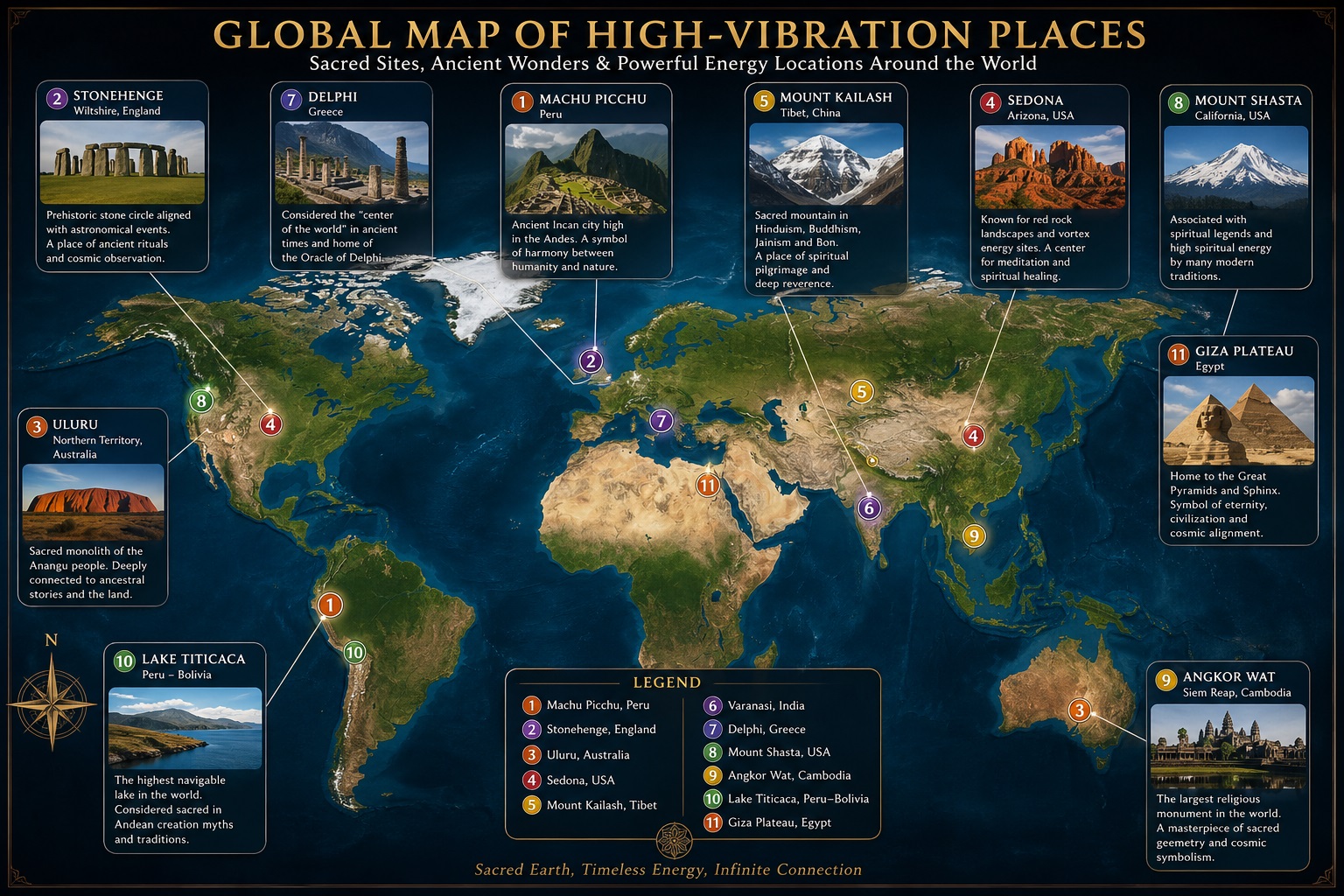
The Most Important “Energy Spaces” in the World, Known for Their Vibration and Unique Qualities
The idea of “energetic places” or “high-vibration locations” is not a scientific classification, but rather a cultural, spiritual, and symbolic interpretation of certain landscapes and historical sites. These places are often experienced as powerful due to their natural beauty, historical depth, silence, isolation, or sacred significance.
Below are some of the most commonly referenced locations worldwide in this context:
🏔️ Machu Picchu
An ancient Incan city located high in the Andes Mountains. Its dramatic setting and architectural harmony with nature make it one of the most iconic places associated with balance between humans and the natural world.
🗿 Stonehenge
A prehistoric stone circle aligned with astronomical events. It remains one of the most mysterious ancient structures, often associated with ritual, time cycles, and celestial observation.
🏜️ Uluru
A massive sandstone monolith sacred to the Anangu people. It is deeply connected to Indigenous spirituality, storytelling, and ancestral tradition.
🌵 Sedona
Famous for its red rock formations and desert landscapes. It is widely known in modern spiritual culture as a place of “energy vortexes” and meditation retreats.
🏔️ Mount Kailash
A sacred mountain in Hinduism, Buddhism, Jainism, and Bon. It is considered one of the holiest places on Earth and has never been climbed out of religious respect.
🕉️ Varanasi
One of the oldest continuously inhabited cities in the world, located on the Ganges River. It is considered a place of spiritual purification and liberation.
🏛️ Delphi
In ancient times, regarded as the “center of the world” and home of the Oracle of Delphi. It was a major site for prophecy, decision-making, and spiritual guidance.
🏔️ Mount Shasta
A volcanic mountain associated in modern spiritual traditions with mystical narratives and perceived energetic significance.
🛕 Angkor Wat
The largest religious monument in the world, originally Hindu and later Buddhist. Its architecture reflects cosmic order and sacred geometry.
🌊 Lake Titicaca
The highest navigable lake in the world, considered sacred by Andean civilizations and linked to creation myths.
🏜️ Giza Plateau
Home to the Great Pyramids and the Sphinx. It is one of the most studied archaeological regions, often associated with eternity, civilization, and cosmic symbolism.
🧭 Important Note
The concept of “energy vibration” is interpretive rather than scientific. However, these places are universally recognized for their: historical and cultural significance # natural or architectural grandeur # psychological and emotional impact on visitors # deep spiritual or mythological traditions
