
Celebrity & Gossip
One in A Billion Moments in Nature
From a fluff fire in Spain that left behind large patches of fresh green grass, and a lightning storm in Kazakhstan that caused the hair on everyone’s head to stand up, to a small village in Odisha, India that might be haunted by angry underground spirits, and rare footage from Canada showing a moose shedding its antlers, here are some more one-in-a-billion moments in nature. These friends in Aktau, Kazakhstan, were in way more danger than they realized. The small city sits on the eastern shore of the Caspian Sea.
This group was likely on the city’s eastern outskirts when a thunderstorm moved overhead. That’s when they began noticing a strange phenomenon. They could hear static electricity, and the hairs on their arms and heads were standing straight up.
One of them pulled out their phone to record, not knowing how dangerous the situation was. Wow! According to the National Weather Service, everything you just saw indicates an imminent lightning strike. This group didn’t realize it, but they rolled the dice by standing straight up.

If this ever happens to you, you should get as low and small as possible without laying flat on the ground. Their hair is standing up due to the positive charges rising through their bodies and toward the negatively charged particles in the storm. That also explains the tingling sensation on the skin and the strange sounds they were hearing.
This was literally Mother Nature telling them to run away. They’re lucky she decided to back off. The Biokovo region is Croatia’s second-largest mountain range.
It runs along the Dalmatian coast of the Adriatic Sea, between the Settina and Naretva rivers. The gorgeous landscape attracts hikers and climbing enthusiasts from around the world. On June 2nd of 2024, two men were hiking the Biokovo range when they spotted a mountain goat hopping around on the rocks.
It must have caused one to slip because the next thing our hikers knew, a rapid rock slide was heading right for them. Thankfully, it was narrow enough for them to sidestep and enjoy. Now be honest, if you were there, would you have stuck your foot inside just to see what would happen? It’s unclear how long the rock slide went on for.
This clip, in total, is about a minute long. It clearly started before our cameraman began recording and continued long after. From what they could tell, the slide consisted of small rocks on the bottom and larger rocks on the top.
It’s amazing to think that all those stones were sitting in one place only moments before. All it took was a little push to trigger this wild domino effect. Now we’ve all seen cartoons where there’s a single rain cloud over a sad character’s head.
You’ve probably felt that way a few times in your own life, but did you know it can actually happen? It’s called isolated or localized rain. It’s when it only rains for a short amount of time in a hyper-specific area. In February of 2022, a local man in Palermo, Italy, was lucky enough to catch this rare phenomenon on camera.
According to our cameraman, this is the second time in six years he’s been there to record isolated rainfall. In 2016, he posted a similar video that went viral in a heartbeat, racking up millions of views. It might look like a pipe leaking from one of those buildings, but you can tell it’s coming from the sky when he points the camera straight up.
Something similar happened in Xiangtan, China, on February 1st of 2024. While on his way home from work, a man noticed it raining in one specific spot. This phenomenon is also called Fantozzi’s cloud, popularized by the 1975 Italian film Fantozzi.
The film is a satire about middle-class life in 1970s Italy. At one point, the characters are followed by individual rain clouds. So, next time you feel like there’s a rain cloud over your head, look up.
There might be. Mahakalapada is a small village in the Chandrapara district of Odisha, India. On June 5th of 2020, its small population experienced something odd and unexpected.
Some might call it borderline supernatural. Without warning, the ground began rumbling beneath their feet. Then, mud and boiling water started spewing all around them.
Locals scrambled away as the situation grew more volatile. At first, the only rational explanation was that the spirits were angry and the ground must be haunted. Then, when they looked deeper into it, they realized what actually triggered the event.
A local man had been digging a well in his backyard. According to witnesses, the drilling team dug about 1,000 feet into the ground. They accidentally struck a pocket of hot, muddy water, causing it to spew 40 feet into the air.
The disruption caused the ground to shake, leading to a small sinkhole opening in the area. Thankfully, nobody got hurt or burned during the incident. Derek Burgoyne is a Forestry Operations Supervisor in New Brunswick, Canada.
He works specifically in Plaster Rock, a small village in Victoria County that’s now part of the Tobique Valley. The local forests are full of wild animals, including bobcats, black bears, and white-tailed deer. But one animal stands tall among them, the Canadian moose.
While recording with his drone, Derek stumbled upon three of these majestic creatures. One stood up and shook the snow off, at which point Derek captured something extraordinary. As the moose shakes his body, he suddenly sheds his antlers.
It must have freaked him out because it quickly bolted away and into the forest. Luckily, Derek knew where the moose was and could retrieve his new trophy. According to Derek, catching this on camera was so rare it was like winning the lottery.
The antlers measured about 45 inches across, which comes into perspective when Derek holds them both against his head. So, why do moose shed their antlers? It typically happens every winter. They’ll ditch last year’s heavyweight antlers and grow new ones in time for spring.
This process is standard for hoofed mammals, or cervids, such as moose, deer, and elk. Fun fact, caribou are the only cervids where the females grow and shed antlers as well. They shed the antlers because the mating season is over.
At that point, they’re more of a hassle, if anything. The moose becomes more mobile, thus making it easier to find food in the winter. Calahora, Spain is a small municipality in the state of Rioja Baja.
It’s home to about 24,000 people who all enjoy a relaxing day in Parque del Cidacos. Unfortunately, their day at the park was ruined on May 14th of 2020 when a small fluff fire broke out. Watch as it burns across the top of the grass, leaving behind an untouched green pasture.
How is this even possible? According to a tree expert at the Australian National University, the white fluff you see on the ground is a mass of tiny fibers meant to carry poplar seeds with the wind. Even a slight gust can carry them far from the mother plant. As we see in this video, those fibers can be highly flammable.
It’s unclear if someone lit the fire to remove the fluff or if it began accidentally. According to the mayor of Calahora, nothing about this was intentional. The fire department had to swoop in and prevent it from further damaging the park.
The Peak District is a highlands area in Derbyshire, England. It’s divided into two peak areas, the Dark Peak, a moorland covered in gritstone, and the White Peak, a mix of valleys and gorges rich with limestone. The highest point in the Peak District is a 2,000-foot moorland plateau called Kinder Scout.
It’s also where you’ll find Kinder Downfall, the tallest waterfall in the Peak District. The near-100-foot waterfall attracts tourists from around the UK because of its strange behavior during windstorms. Some swear it’s the only waterfall on Earth that flows backward.
However, contrary to popular belief, Kinder Downfall is not technically flowing backward. What you just saw from January of 2016 happens whenever gale-force winds crash into the mountainside. They blow so fast that the water travels back up and over the top.
This event was caused by Storm Gertrude, which brought 100-plus mile-per-hour winds to Scotland and Northern England. What you see at Kinder Downfall is wholly weather-dependent. For example, it’ll freeze in the winter, attracting ice climbers from across the UK.
However, the waterfall tends to dry up in the summertime, leaving nothing but a blank rock wall. You’ll have to brave heavy rain and powerful wind to catch the backward waterfall. But, as they say, the best things in life don’t come easy.
Sergut, Russia is a Siberian city on the Ob River. It’s home to about 400,000 people who are used to the area’s subarctic climate. They experience long, freezing winters and short, warm summers.
It’s not uncommon for layers of ice to form on the Ob River, leading to scenes like this from 2018. It was May, when the average temperature in Sergut sits around 58 degrees Fahrenheit. The top layer of ice on the Ob began melting and crashing into the shore.
One ice wave eventually grew beyond control and broke through some metal fencing along the barrier wall. According to some sources, the local government will occasionally use explosives to combat overflowing ice on the Ob River. We’re guessing it’s their way of controlling the ice melt to avoid situations like this.
But, as we’ve learned, when Mother Nature wants her way, she usually gets it. In 1864, President Abraham Lincoln signed the Yosemite Grant, thus declaring Yosemite as federally protected land. About 30 years later, it became one of the first national parks in America, alongside Yellowstone, General Grant, and Mount Rainier.
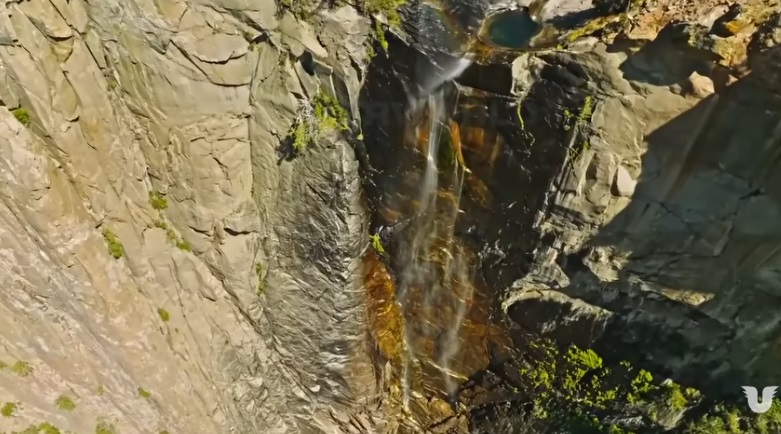
Every year, about 4 million people travel to Yosemite, with many coming to its gorgeous waterfalls. One in particular, Horsetail Falls, isn’t typically at the top of anybody’s list. Even though it stands over 2,100 feet tall, the small stream atop El Capitan doesn’t pack the same punch as Yosemite Falls or Bridal Veil Falls.
But, if you catch Horsetail Falls at the right time and under the right conditions, it instantly becomes the most incredible waterfall in Yosemite. For starters, Horsetail only flows during the winter, so it’s easy to miss. On ultra-rare occasions, in mid to late February, it’ll glow a fiery orange when the sun reflects off El Capitan.
Visitors call it the Yosemite Firefall, even though no fire is actually falling. From this angle, you can see where the name comes from. If you didn’t know any better, you might think a volcano had erupted in the distance and the magma was flowing over El Capitan.
But, whether El Capitan takes on this glowing effect depends on your perspective. Here, you can see it’s just the light reflecting off the mountain. On this particular day, Horsetail Falls wasn’t flowing very strongly.
Only a slight mist was rolling over El Capitan, which is why the firefall effect doesn’t look as advertised. Still, that didn’t stop hundreds of visitors from braving the California cold to get a good shot of the mountain. According to our resident Red Sox fan, nothing compares to the real thing.
He’d seen plenty of pictures of the Yosemite Firefall, but, like everyone else in the park, wanted one of his own. Chongqing, China is one of four direct-administered municipalities under the Chinese government. The other three are Beijing, Shanghai, and Tianjin.
It’s one of China’s largest cities, with about 30 million people living in a land area roughly the size of Austria. Many of those people live in the rural outskirts of Chongqing. Some of them may have been lucky enough to experience this natural phenomenon on May 5th of 2024.
It’s called a cloud waterfall. According to experts, cloud waterfalls only happen under certain conditions. For starters, they only develop during the clear weather immediately following a heavy rain or snowstorm.
That’s because the rain and snow work to moisten the atmosphere. Then, there’s the matter of terrain. Cloud waterfalls only occur over mountain slopes surrounding an elevated plateau, as seen in this video.
When these conditions are met, clear skies help the air to cool and saturate, thus allowing this sea of clouds phenomenon to occur. Eventually, the cooler, denser air atop the plateau builds to the point where it spills over the mountain. Gravity does the rest from there.
Unfortunately, it doesn’t last very long, as the clouds evaporate on their way down the mountain. But, if you’re in the right spot at the right time, you should be able to see this one-in-a-billion moment in all its glory. If you enjoyed this video and want to see another just like it, then be sure to click the link on screen now.
With that, thanks for watching, and we’ll catch you in the next one.
Source: Underworld