Economy
BRICS Set to Condemn Trade-Distorting Tariffs in Swipe at Trump

BRICS leaders are set to adopt a position opposing President Donald Trump on trade tariffs, conflict in the Middle East, and global arms spending in a draft statement.
The statement expresses “serious concerns” about unilateral tariff and non-tariff measures, condemns economic sanctions, and criticizes military strikes against Iran and the situation in the Occupied Palestinian Territory.
The leaders also express alarm at the increase in global military spending, back the Paris climate agreement, and call for global governance of artificial intelligence, all of which are at odds with Trump’s policies.
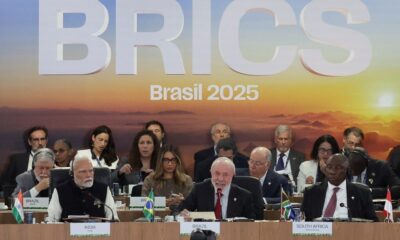
BRICS leaders are poised to adopt a position at odds with President Donald Trump on trade tariffs, conflict in the Middle East and global arms spending, even as they shy away from any direct challenge to the US.
In a draft statement prepared for their meeting in Brazil starting Sunday, leaders agreed to voice “serious concerns” about the rise of unilateral tariff and non-tariff measures “which distort trade and are inconsistent with WTO rules,” according to a version of the final text.

The government chiefs additionally agreed to “condemn the imposition of unilateral coercive measures that are contrary to international law,” specifically economic sanctions, the text states. The final wording of the concluding communique could still change.
While not mentioning the Trump administration by name, leading emerging-market nations are clearly referring to the US in the wake of the president’s tariffs imposed on countries worldwide. Facing punitive levies, nations including founding BRICS member India are racing to strike deals with the US ahead of a July 9 deadline Trump has given for the tariffs to take effect.
At the same time, the reluctance to call out Trump or the US by name reflects divisions within the bloc, with some closer to Washington than others, and members such as India wary that BRICS could become a vehicle for its largest member economy, China. Members are still unable to identify a common position regarding representation on the UN Security Council.
Even so, BRICS nations hosted in Rio de Janeiro by Brazilian President Luiz Inacio Lula da Silva are at cross-purposes with the Trump administration on multiple aspects of policy.