


Culture & Arts
10 Most Famous Gaudi Masterpieces in Barcelona You Need to Know About
Barcelona is renowned as a vibrant hub of artistic expression and architectural wonders. At the heart of its allure lie the magnificent works of Antoni Gaudí. A Gaudi Barcelona exploration is simply not to be missed, to truly appreciate his visionary creations that have left an indelible mark on the cityscape.
We spoke with Amada, a Spanish native and Barcelona Local Expert for over 20 years. She tells us more about this renowned Catalan architect, and talks us through some of the great Gaudi works that you must not miss.
“With Gaudi, nothing is by coincidence,” Amada says. “Everything has a reason, a motive. Every little detail is considered, and nothing is there by chance.”
Don’t miss our September Sale – explore Barcelona’s unique architecture for less

Antoni Gaudi – An architectural legend
Gaudi’s distinctive architectural style seamlessly blends organic and geometric elements, showcasing intricate details, vibrant colors, and a harmonious integration with nature. His extravagant, shapeshifting structures, drawing on a wide variety of influences, led him to become one of the most famous architects of the early 20th century. Antoni Gaudi was also a leading contributor to bringing Art Nouveau into Spain, and creating the country’s own interpretation of the art movement; Modernisme. Take the time to explore Gaudi buildings in Barcelona and you’ll be drawn into a world of art, history and storytelling.
“Gaudi did not have a happy life,” Amada tells us. “He suffered from rheumatism from childhood and had to go slowly.” According to researchers, this is partly why he became such a good observer.
“He had plenty of time to watch how the trees and leaves grow, and how nature developed around him. He later came to the conclusion, that nature ‘teaches us how to do things.’
“Gaudi would say ‘look around, nothing alive is straight. The trees are not straight, and they don’t fall. The human body is not a straight line or the animals. Why should my buildings be straight?
“So, the lines of curves that he used are from nature. The hyperboloid, the paraboloids, the conoid and all these geometric figures. He used them because they exist in reality. Straight lines are not really the good ones, they’re in fact weak and insufficient.”
You might be interested to read: 9 reasons why Best of Spain & Portugal is a simply unmissable tour
- La Sagrada Familia
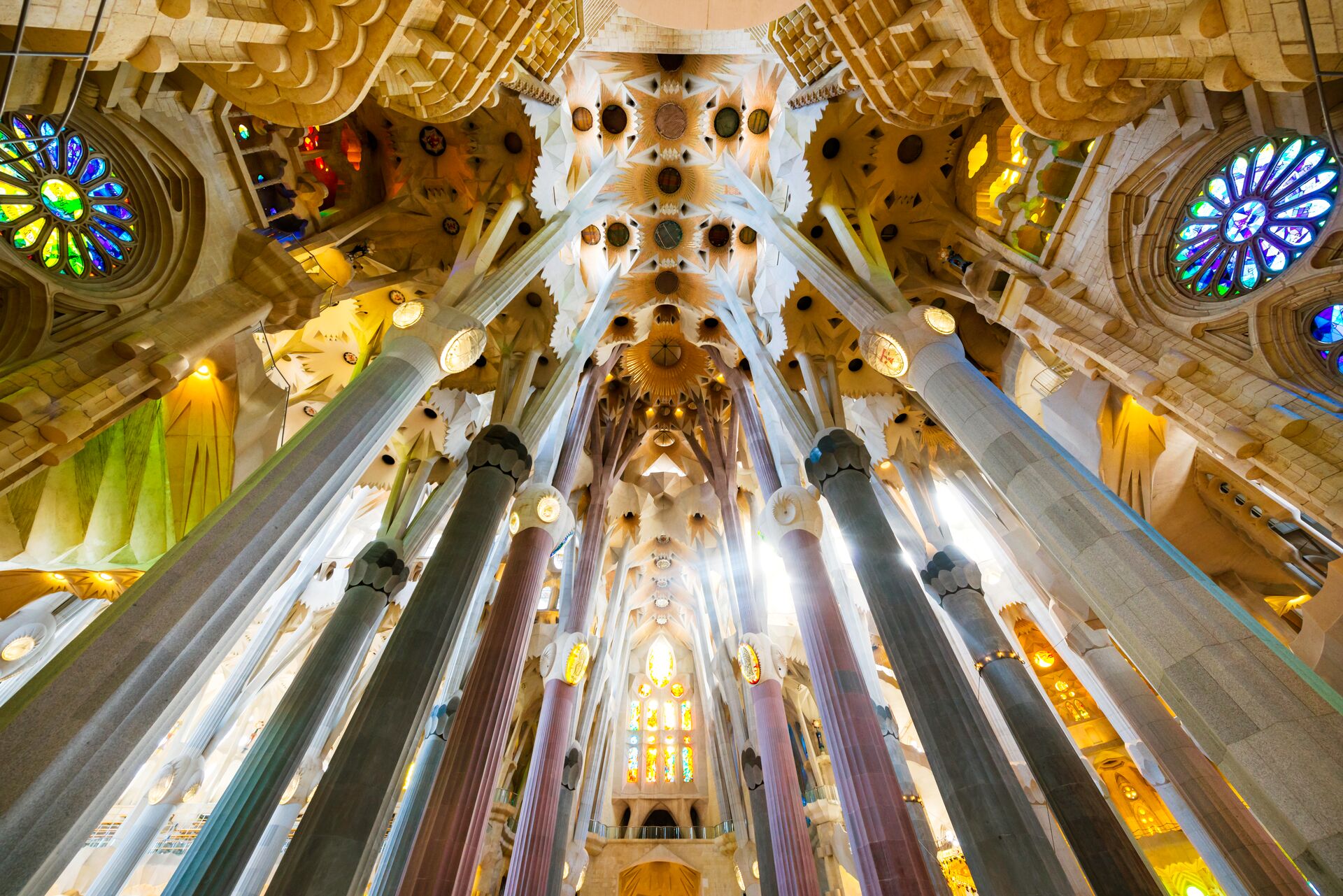
No mention of Gaudi can be made without talking about the Sagrada Familia. This famous church and architectural marvel is one of his most world-renowned works. It is considered to be the symbol of Barcelona by many residents.
The basilica illustrates Gaudí’s belief that nature is a divine creation. He aimed to unite Christian speech and biblical parables with intricate natural symbols gracing every column, pinnacle and stained-glass window. The church is a striking example of Gaudi’s use of the hyperboloid vault. This is the
The Gaudí House Museum, located within the Park Güell in Barcelona, is a historic home museum that houses a collection of furniture and objects designed by the Spanish architect Antoni Gaudí. It was the residence of Antoni Gaudí for almost 20 years, from 1906 till the end of 1925.curve created when a double cone Is sliced vertically, creating fairly high vaults. Gaudi used this to create pillars that resemble the structure of of tree complete with branched tree trunks.
The result is a stunning feat of architecture that, despite its incomplete state and ongoing construction spanning nearly 140 years, has emerged as one of Spain’s most frequented landmarks.
Catalan artist Josep Maria Subirachs provided the sculptures, carving 100 stone figures and made four vast bronze doors for the church’s west facade.
“When people see the Sagrada Familia for the first time, it’s more than they expect, people sometimes cry,” Amada tells us. “It’s like nature in architecture, a forest made of rock. It is really impressive and beautiful.”
Discover Gaudi works whilst in Barcelona on: Highlights of Spain
- Colonia Guell
Located 20 km outside the city, the village of Colonia Guell plays an important part in the Gaudi Barcelona story. “The industrial tycoon Eusebi Guell was the first client and subsequent patron of Gaudi,” Amada tells us. “In fact, he was a bit of father figure. Gaudi was a gifted person, but he also had this man behind him, supporting him when he doubted himself.
“Mr Guell wanted to take his textile factory out of the city to escape the unions. He bought the land, constructed the factory and housing for the workers and Gaudi was commissioned to build the church.
“The church was never finished,” Amada explains. “Gaudi only did the crypt and that took him 14 years (1898 – 1914). But even for only the crypt it is extremely worth going to see.
“Why? Because that work there was the lab for La Sagrada Familia. Gaudi was gaining knowledge, researching materials, the structure of the columns, all in the little crypt in Colonia Guell. In fact, if he had completed the Colonia Guell church, it would probably have been a scale model of La Sagrada Familia. That’s why it is so important.”
- Casa Vicens
“Casa Vicens was the first house Gaudi constructed after his university studies,” says Amada of this colorful art nouveau house built between 1883 and 1885. “Vicens was a businessman who wanted to have a summer house in Barcelona and asked Gaudi to build it.
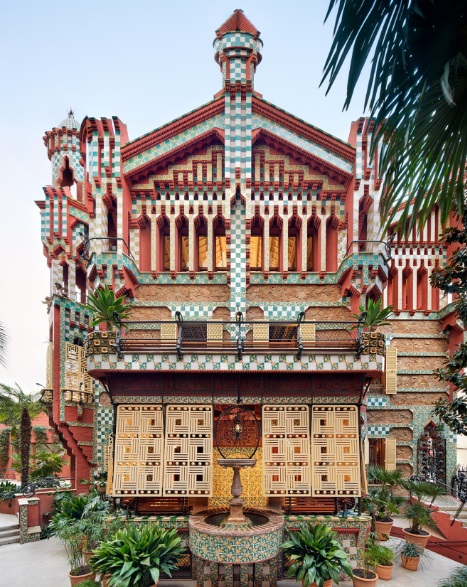
A highlight of any Gaudi Barcelona tour, she explains that “Gaudi made this small house with a focus on the garden that extended in front, with a waterfall, the atmosphere of the trees and the flowers.
“The house brings outdoors indoors. The same Ivy leaves or carnations or whatever Gaudi found on the land he put it into the house, on the walls, inside the bedrooms in paper mache. It is really delightful.”
- La Casa Calvet
“La Casa Calvet is interesting as it is an apartment building,” says Amada. “Built for the Calvet textile family as a place to both live and work, the building was in the middle of others, providing a challenge for Gaudi because he had no more space.
The resulting building façade is elegant, with symmetry and straight lines, quite untypical for Gaudi.
“This was the only building for which Gaudi received a prize,” says Amada. “Despite his fame, Gaudi never got any recognition from his fellow citizens. He was the crazy one to the local people in his time. But in 1900 La Casa Calvet was awarded the ‘best building of the city.’
- Casa Batlló
Casa Batlló, located on Barcelona’s Passeig de Gràcia, is a stunning example of Gaudí’s Modernista style. Completed in 1906 and known locally as the “House of Bones” due to its skeletal balconies and columns, Casa Batlló was a renovation of an existing building for the Batlló family.
The building’s façade is instantly recognisable, creating a wave-like effect with its mosaic of broken ceramic tiles. Inside, Gaudí’s organic designs continue with swirling ceilings and curved walls, while stained glass windows bathe the interiors in colored light. On of the most fascinating Gaudi works, the roof, resembling the scales of a dragon, is particularly striking. Legend has it that Gaudí drew inspiration from the story of Saint George and the Dragon, making Casa Batlló a blend of both myth and architectural genius.
- Casa Milà (La Pedrera)
A mix of surreal design and architectural ingenuity, Casa Milà, popularly known as La Pedrera (The Quarry), is one of the most ambitious residential Gaudi building in Barcelona. Completed in 1912, it was declared a UNESCO World Heritage site in 1984. Situated on Passeig de Gràcia, it features a rough-hewn stone façade that undulates like a natural rock formation, with wrought-iron balconies resembling vines.
Gaudí’s innovative use of light and space is evident in the building’s interior courtyards and self-supporting stone façade, eliminating the need for load-bearing walls. The rooftop with its whimsical chimneys and ventilation towers, offers panoramic views of Barcelona.
A great read for art lovers:A Century of Surrealism: Investigating the Legacy of Salvador Dali’s Art
- Colegio Teresiano de Barcelona
Colegio Teresiano de Barcelona, designed by Gaudí between 1888 and 1889, is a lesser-known but significant work, showcasing his early architectural style. The school, built for the Order of the Discalced Carmelites of Saint Teresa of Jesus, features a more restrained design compared to Gaudí’s later works.
The building’s brick façade is adorned with Gothic-inspired arches and geometric patterns, reflecting Gaudí’s ability to blend form with function. Inside, the use of natural light and simple, elegant lines creates a serene atmosphere conducive to learning and contemplation.
Source: insightvacations.com
