Tech & Media
Astronomers Have Traced Our New Interstellar Comet’s Origin, And It’s a First
The third object known to have entered the Solar System from interstellar space has an origin unlike either of its predecessors.
Comet 3I/ATLAS, according to a team led by astrophysicist Matthew Hopkins of the University of Oxford, came to the Solar System from the thick disk of the Milky Way, a region very different from the environment in which the Sun now dwells.
Their findings, arrived at within mere days of the object’s discovery, have been submitted to The Astrophysical Journal Letters, and are available on arXiv.

The Solar System is full of rocks, and most of them were born right here, from the cloud of material that was left over from the birth of the Sun. Thanks to gravitational interactions and the ongoing dynamical evolution of the system, there are many different paths they can travel as they loop around the Sun, from long-period objects with orbits of up to millions of years, to rocks interior to the orbit of Venus.
On just three occasions now, astronomers have seen objects moving through the Solar System on paths that can only be explained if that object had come from somewhere outside of the Solar System, from very far away.
The first two were ‘Oumuamua and comet 2I/Borisov, appearing in 2017 and 2019, respectively.
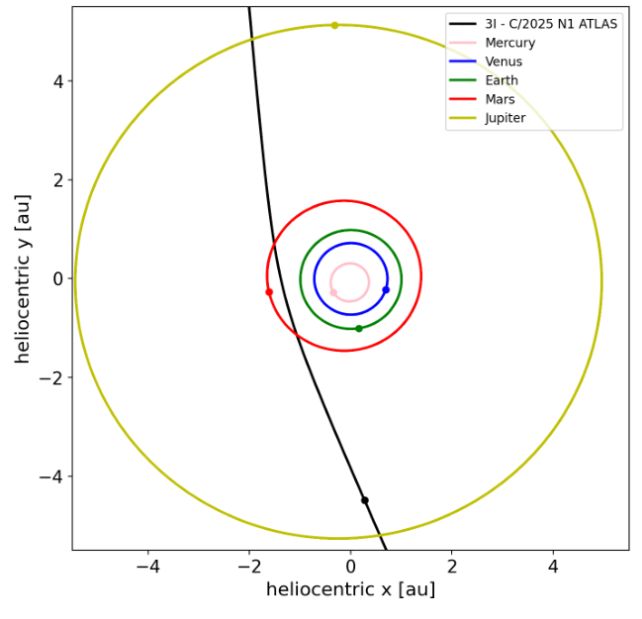
Comet 3I/ATLAS, discovered on 1 July 2025, is the third, and astronomers have been busily working to figure out where it’s going, what it looks like, and where the heck it came from out there in the wider galaxy.
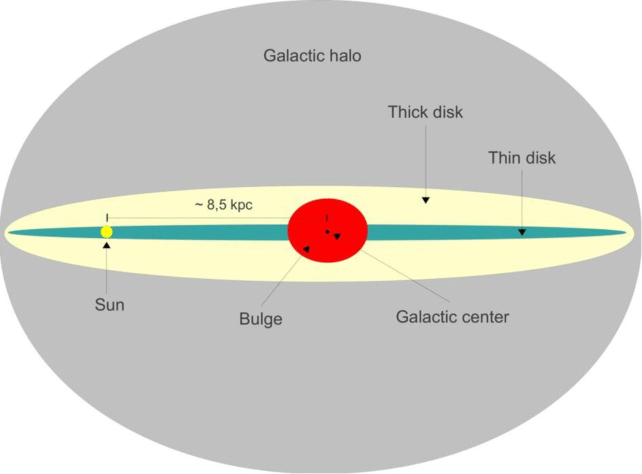
Hopkins and his colleagues applied a protocol known as the Ōtautahi-Oxford interstellar object population model, jointly developed by astronomers from New Zealand and the UK, to backtrace 3I/ATLAS to its point of origin in the Milky Way. This model uses Gaia data in conjunction with models of the chemistry of the Milky Way’s disk and the way objects move around to map populations of interstellar objects.
3I/ATLAS was traveling at a velocity of 57 kilometers (around 35 miles) per second on discovery, on a path that will bring it just inside the orbit of Mars for its closest approach to the Sun in October 2025 before it heads back out of the Solar System. It’s thought to be around 10 to 20 kilometers across, with a bluer surface hue and redder coma than most Solar System comets.
Source: sciencealert.com