Culture & Arts
The Interconnected Stability of Today’s World — Economy, Culture, Politics, and Spiritual Balance
International Affairs & Human Development Desk
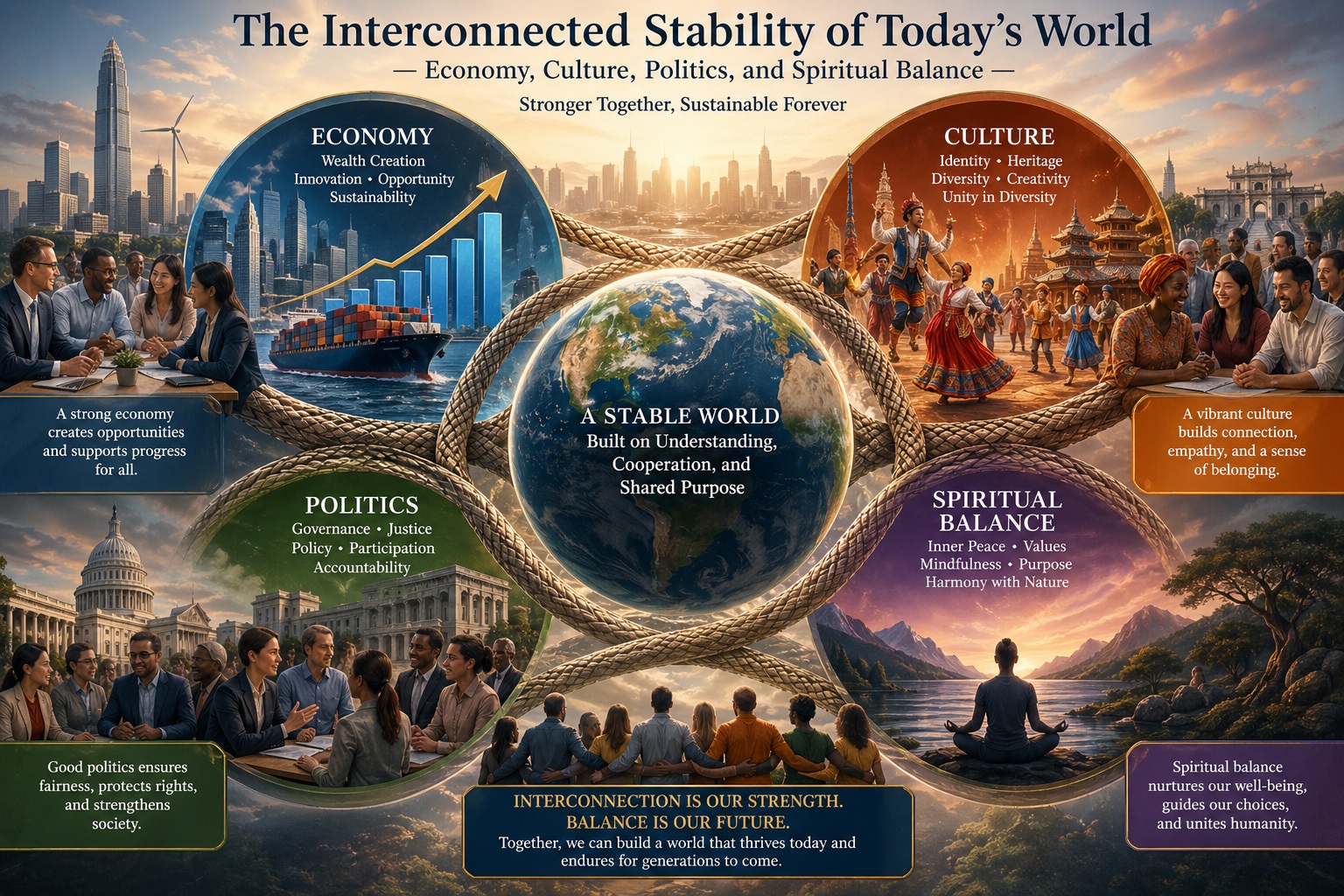
In an increasingly complex and fast-moving world, stability is no longer shaped by a single force. Instead, it emerges from the delicate interplay between four fundamental pillars: the economy, culture, politics, and spiritual well-being.
Economic systems provide the material foundation of society, influencing access to resources, opportunities, and overall quality of life. Yet, economic growth without cultural awareness risks creating imbalance—where progress benefits a few while disconnecting communities from their identity and shared values.
Culture, in turn, acts as the social glue. It shapes how we relate to one another, how we interpret change, and how resilient we are in times of uncertainty. A strong cultural framework fosters inclusion, creativity, and continuity, even when external pressures mount.

Politics plays a crucial role in maintaining order and direction. Transparent governance, accountability, and cooperation across borders are essential in a globalized era where decisions in one region can ripple across the world. Political stability, however, must be rooted in fairness and dialogue to truly sustain peace.
Equally vital—but often overlooked—is spiritual balance. Whether expressed through faith, philosophy, or personal reflection, it provides individuals with a sense of purpose and inner stability. In times of crisis, spiritual resilience can be the anchor that keeps societies grounded.
True global stability lies not in dominance of one pillar over the others, but in their harmony. When economic systems are inclusive, cultures are respected, politics are just, and individuals are spiritually grounded, the world becomes more adaptable, compassionate, and resilient.
The future will not be shaped by isolated systems, but by how well we understand and nurture their interconnectedness.
In an era defined by rapid transformation, the question of global stability has become one of the most important themes shaping international discourse. Across economic systems, cultural landscapes, political frameworks, and even spiritual perspectives, nations are increasingly interconnected in ways that influence collective resilience and long-term balance.
Experts describe today’s world not as a static system, but as a dynamic network where stability is continuously negotiated through cooperation, adaptation, and shared responsibility.
Economic Stability: Interdependence as the New Foundation
Global economic stability is increasingly shaped by interconnected markets, supply chains, and digital infrastructure. Institutions such as the International Monetary Fund and the World Bank emphasize that resilience now depends on diversification, technological innovation, and sustainable investment.
Key stabilizing factors include:
- Cross-border trade integration
- Digital financial systems and fintech expansion
- Energy transition toward renewable resources
- Regional economic cooperation blocs such as the European Union
Despite periodic fluctuations, global markets remain interconnected in ways that distribute both risks and opportunities across regions.
🏛️ Political Stability: Cooperation Over Isolation
Modern political stability is increasingly shaped by multilateral diplomacy and international governance structures. Organizations such as the United Nations continue to play a central role in conflict mediation, humanitarian coordination, and global policy alignment.
Factors contributing to political stability include:
- Diplomatic negotiation frameworks
- Regional alliances and cooperative treaties
- Strengthening of institutional governance
- Information transparency and global communication systems
While geopolitical tensions remain present in various regions, there is a growing emphasis on dialogue and conflict prevention mechanisms.
🌐 Cultural Stability: The Strength of Diversity
Cultural stability is no longer defined by uniformity, but by the ability of diverse identities to coexist and interact constructively. Global migration, digital communication, and education systems have accelerated cultural exchange at an unprecedented scale.
Key stabilizing forces include:
- Preservation of cultural heritage
- Global access to education and knowledge
- Intercultural dialogue through media and technology
- Recognition of indigenous and local traditions
This cultural interconnection has created a more fluid global identity, where differences are increasingly seen as assets rather than divisions.
🧘 Spiritual and Human Consciousness: A Subtle Dimension of Balance
Alongside material systems, many scholars and thinkers highlight a growing global interest in inner development, mindfulness, and ethical awareness. While not a political or economic force, this dimension influences how individuals and societies interpret responsibility, consumption, and coexistence.
Trends include:
- Expansion of mindfulness and mental well-being practices
- Increased interest in ethical leadership
- Integration of values-based education
- Cross-cultural spiritual dialogue
This reflects a broader shift toward understanding stability not only as structural, but also as psychological and collective.
🤝 The Core Drivers of Global Harmony
Across all domains, several key factors consistently emerge as foundational to global stability:
- Interdependence between nations and systems
- Technological connectivity and communication
- Education and knowledge sharing
- Institutional cooperation and governance
- Environmental awareness and sustainability
🌏 A Connected Future
The modern world is increasingly defined by the principle that no nation operates in isolation. Economic systems influence cultural trends, political decisions affect global markets, and collective awareness shapes long-term sustainability.
Rather than a fragmented global order, experts describe the current era as a network civilization — one where stability emerges not from uniformity, but from coordinated diversity.
As one international analyst summarized:
“Global stability today is not the absence of change, but the ability of humanity to evolve together without losing balance.”